What Happens To Dead Trees in the Forest?
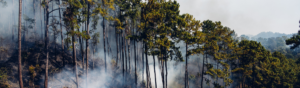
Think of a dead tree that falls anywhere. If left alone, it will eventually appear to disintegrate. It may take decades, but the big, thick tree trunk eventually turns into a small mound of damp sawdust. This isn’t passive disintegration or mystical evaporation. This happens through an active process of decomposition and consumption.
What is decomposition? It is the active process through which organic matter is broken down and consumed by other organisms. That’s right: the dead tree dissolves because something is actively consuming it. That’s true no matter how slow the process may seem.
Where do mushrooms grow? Dead wood, dead trees. Why do the mushrooms grow there? Because the nutrients they need are there. The mushrooms feed on the decaying tree; they are part of the process of consuming it. Thousands of species of bugs, beetles, and soil bacteria are also actively eating and consuming the tree trunk. If this weren’t occurring, the whole planet would be thousands of feet deep in dead trees, branches, and leaves.
The dead wood isn’t just left there. It doesn’t go to waste. It becomes food for countless bugs, plants, and bacteria.
Cow Manure and the Natural Process of Decomposition
Cow patties, like dead trees, don’t just disintegrate or evaporate. Birds, bugs, and soil bacteria literally eat and digest them. Have you noticed places in a yard where the grass grows taller and greener where an animal pooped? That’s because the soil bacteria and bugs digest and convert the waste in that poop into nutrients that the grass needs to grow.
That poop isn’t wasted. It literally feeds the grass. (Well, as long as the poop isn’t full of chemical preservatives—more on that in a later blog.) Consider mushrooms and beetles. Or think of bacteria and vultures consuming a dead animal on the side of the road. Everything that dies is decomposed by other organisms that use it as a food source.
I think most people understand the basics of this concept. However, it’s harder to fully grasp that it applies to every living organic thing. When we understand how nature breaks down, recycles, and repurposes dead or decaying material, we can ask better questions about what happens inside our pets’ bodies and why. That same principle of natural balance is an important foundation for understanding the philosophy behind holistic pet care, which looks beyond symptoms to consider the whole animal and the biological processes that influence health.
Why Bacteria & Parasites Are Present
Let’s now try to look at this from the other side. What I mean is: instead of thinking about why the dead tree or dead animal eventually disappears, let’s look at why the bugs, bacteria, and vultures are present.
These scavengers and consumers are present solely because they have a food source. If they had no food – like a dead tree or a dead animal carcass – then they would fade into extinction. A good example of this is parasites, especially intestinal parasites. Whether in a human or a dog, “worms” like roundworms, hookworms, or whipworms, or more “aggressive” intestinal parasites such as Giardia or Coccidia, live in the gut because there is a food source there.
They aren’t random invaders. They become established in the gut solely because there is some toxic or decaying natural or unnatural waste that they are seeking. Millions of bacteria live in our gut for this very purpose: to help digest food and waste products. But when the wastes are too toxic, or there is excess decay or incompletely digested food, that is when we see “infections” with worms, parasites, and more aggressive “bad” bacteria.
Understanding Why Illness Happens
When a person or pet contracts an illness, usually a bacterium or virus, it is always because there is something in the body that the bacterium (Lyme, Leptospirosis, Bordetella…) or virus (Parvo, Distemper, Flu, COVID, Measles…) is intended to feed on, digest, and consume. Viruses do a bit more than that, though, helping cells adapt to unavoidable inorganic insults. But the same concept applies: they serve a specific purpose and only show up when that need is present.
This doesn’t mean these diseases don’t exist, or that they aren’t sometimes fatal. What it does mean is that we get sick for a good reason. We get sick because something dead, decaying, or otherwise toxic is in our body that bacteria or viruses are actively trying to remove, just like the job parasites do in the gut.
The more toxins or decay present in the body, the more food there is for bacteria or viruses and therefore, the greater the “infection,” because nothing goes to waste in the natural biological world.
Bacteria and viruses are not the enemy. They exist to serve a necessary purpose: to help clean up and maintain balance. When we preemptively kill them with chemicals, we actually make our environment less healthy. This is an important concept to consider when looking at holistic pet care and the health of our pets.
As a provider of holistic pet care, I believe understanding why our pets get sick requires looking beyond the disease itself and considering the whole biological system. When we understand that nothing in nature goes to waste, we can begin asking different questions about what is happening inside the body—and why.
These ideas are at the heart of my practice and my book, Why Our Pets Are Unhealthy, where I explore these concepts and what they can teach us about animal health in greater depth. If you’re looking for holistic pet care that asks better questions, looks beyond symptoms, and considers the underlying factors affecting your pet’s health, I’d be honored to help. Schedule a consultation to begin exploring a more complete approach to your pet’s lifelong health.