
Putting the History of the World Into Perspective
The 4.5-billion-year history of planet Earth is too big a number for most people to comprehend. So, you’ll often find graphics like the one below from Google that condense humanity’s history on the planet into a 24-hour period. This helps us better understand the scale of such a long timeline.
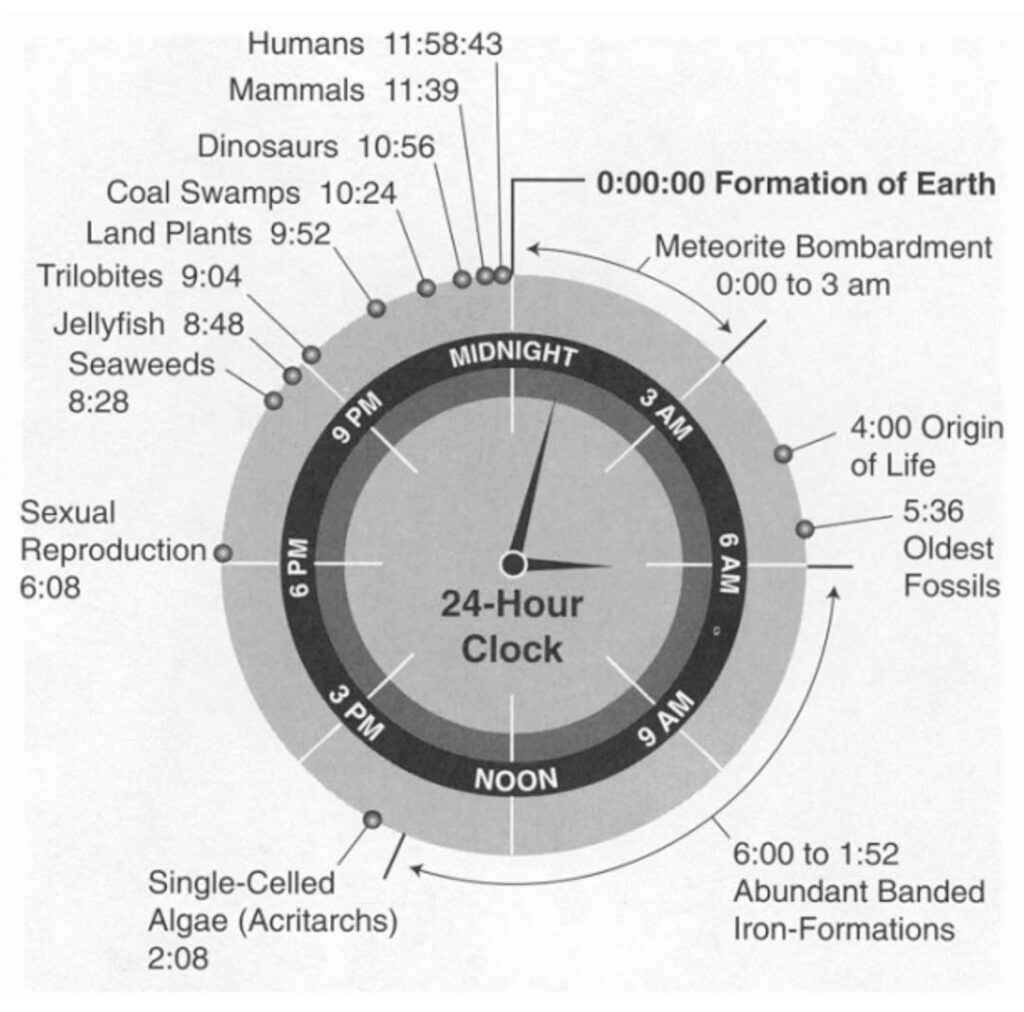
As this image shows, imagine compressing Earth’s entire 4.5-billion-year history into a 24-hour clock. Through this lens, the first Homo sapiens only appeared at 11:58:43 p.m. That’s the precursor to modern humans, arriving about 1 minute and 18 seconds ago. All of our recorded history, approximately the past 1,000–5,000 years, is defined by agriculture, writing, and human technologies. It has existed only during the final second of Earth’s “24-hour” clock. This final second also includes Traditional Chinese Medicine and historical figures such as Aristotle, Galileo, Hippocrates, Newton, and Da Vinci.
Looking at Modern Western Medicine Historically
Now consider modern Western medicine: vaccines, spay-and-neuter procedures, orthopedic surgery, antibiotics, pain medications, and other pharmaceutical or surgical interventions. Compared with humanity’s history, modern medicine is relatively young. Many of its defining practices have developed over just the past 200 years. It’s difficult to compare the history of modern Western medicine to Earth’s lifetime. It’s even hard to compare it to the 1 minute and 18 seconds that Homo sapiens have existed, because it’s such a small fraction of time.
But when we compare modern Western medicine’s existence with recorded human history, the final second of our 24-hour clock, we can begin to appreciate just how recent it is.
The Experience of Modern Medicine Compared With Traditional Approaches
Western medicine represents only a tiny fraction of humanity’s accumulated experience with health and healing. Traditional Chinese Medicine, acupuncture, and other traditional health modalities have been practiced and refined over much longer periods of human history. Modern medicine is relatively new. Like any evolving field, our understanding of health, disease, treatments, and their long-term effects continues to develop.
The same is true of many technologies and chemicals introduced into modern industrial society, including DDT, PFAS, glyphosate, and artificial fragrances. We could also argue that Traditional Chinese Medicine is relatively young when viewed against the planet’s entire history. However, it has a much longer history of human use than modern Western medicine. This distinction matters when we think about natural pet health, holistic pet care, and how we approach our animals’ health.
Questioning the Supremacy of Modern Western Medicine
Do you sometimes find yourself questioning vaccine recommendations, or being prescribed the same medications over and over? Then, do you still notice the same health problem keeps coming back? Do you find that your regular vet becomes dismissive when you question why your pet never seems to stay healthy? Or when you ask questions about vaccinations, medications, or other conventional treatments?
If you find yourself questioning vaccines, medications, diagnoses, or the treatments your pets receive from their regular veterinarian, or questioning some of the conventional approaches used throughout the veterinary industry, it’s reasonable to ask questions.
As pet owners, we should feel comfortable understanding why a treatment is recommended and what its intended purpose is. We should understand what alternatives may exist, and how it fits into our pet’s overall health.
Supporting Natural Pet Health
When we view health through nature and consider the concepts behind traditional modalities such as Traditional Chinese Medicine, along with my favorite concept of Terrain Theory, we can look beyond symptoms alone. This approach may offer additional ways to think about treatment while also considering potential underlying influences on health.
For me, this is where holistic pet care and natural pet health become especially important. Rather than focusing solely on the final symptom or diagnosis, we can consider the broader picture of an animal’s health, environment, nutrition, lifestyle, and overall terrain to address the underlying causes of disease.
If you’re searching for a holistic veterinarian who takes the time to ask deeper questions, look beyond symptoms, and create a personalized care plan for your pet, I invite you to schedule a consultation. Together, we can take the first step toward supporting your pet’s lifelong health and wellness. If you’d like to learn more about my perspective, you can also find my book, Why Our Pets Are Unhealthy, on Amazon.